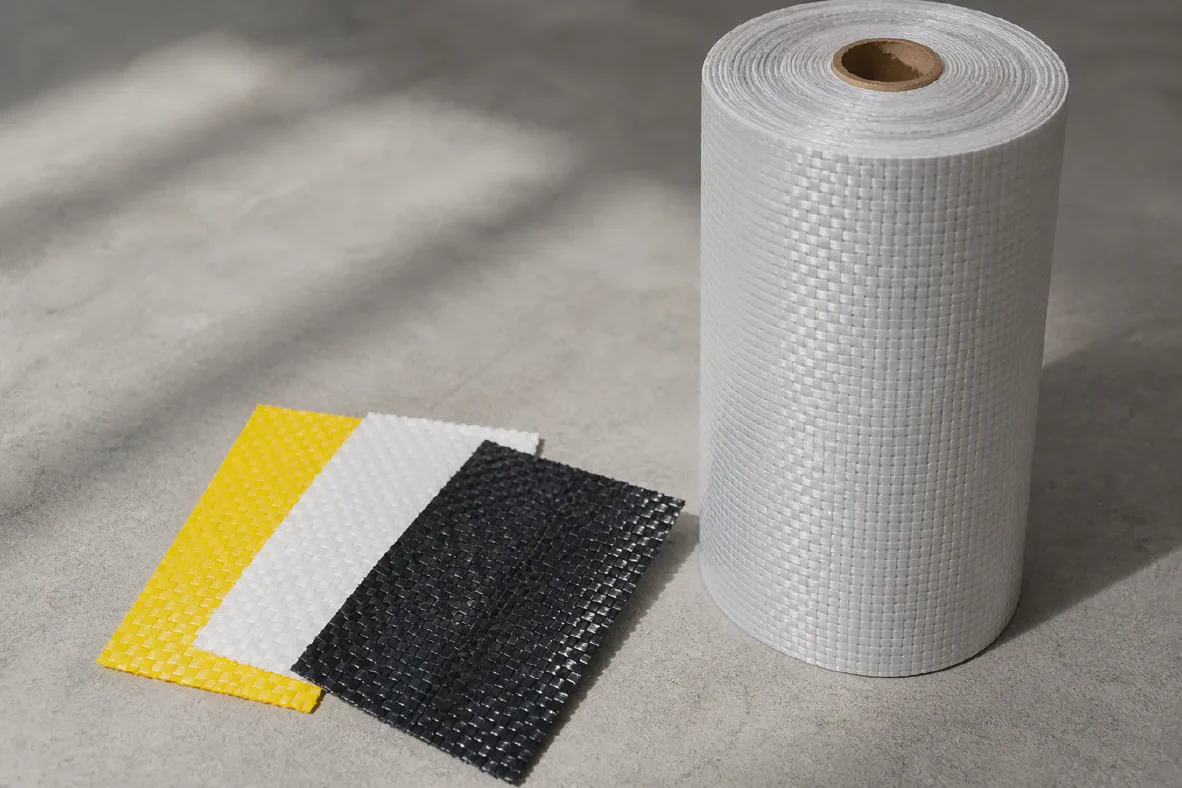
These answers are for bulk buyers of PP woven rolls and PE laminated tarpaulin rolls—not retail tarp kits. Use them with the PP/PE woven roll buyer’s guide. If two suppliers disagree, put the same spec through the quote specification generator and compare with the spec comparison tool.
How to use this FAQ
Read GSM, lamination and roll form first. Then packing, MOQ and container. Price last, after the spec is identical on both sides.
Related calculators: roll weight, container loading, cost drivers.
FAQ
Do you sell finished tarpaulins or roll goods?
Wovenrolls.com is set up for roll goods: PP woven rolls, PE laminated tarpaulin rolls, ground cover rolls and packaging-oriented rolls. Cutting, welding, sewing, eyelets and installation stay with the buyer or converter unless a project is agreed separately.
What is the difference between a PP woven roll and a PE tarpaulin roll?
A PP woven roll is the woven cloth. A PE tarpaulin roll is usually that cloth plus PE film lamination for a more waterproof converting face. Compare structure before you compare GSM or price.
Is laminated always better than unlaminated?
No. Laminated rolls suit tarpaulin conversion and rain covers. Unlaminated rolls suit bags, liners, wrapping and some ground cover. Extra film adds cost, stiffness and freight.
Should GSM include the PE film?
Ask. Some offers quote base cloth GSM; others quote finished laminated GSM. Price per ton or per roll is not comparable until the basis is the same.
What GSM should I start with?
Light temporary covers often start 55–90 GSM. General tarp conversion often 90–160 GSM. Heavy outdoor covers may need 160 GSM and above. Application, UV and lamination still decide the final band.
Is heavier GSM always stronger in use?
Usually more polymer means more mass, not automatically a longer outdoor life. Weave, coating adhesion, UV package and converting method can matter more than a 10 GSM difference.
What is flat versus tubular woven roll?
Flat (open-width) is a single layer for sheets, covers and most tarp lamination. Tubular is a circular-loom tube, often for bags and liners. Write lay-flat width or open width clearly.
Can I use tubular fabric for tarpaulin conversion?
Only if your line is set up for it, or the plant slits the tube. Most tarp conversion programs on this site use flat laminated rolls.
Virgin or recycled PP — which should I specify?
Virgin or high-virgin blends are easier for light colors, printing and critical outdoor covers. Recycled can be fine for dark, cost-sensitive wrapping if you approve a sample and write the recycle rule in the RFQ.
Will recycled rolls fail UV faster?
Not by the word recycled alone. Poor or missing UV masterbatch fails faster. Recycled plus no UV package is the risky mix for outdoor covers.
How do I calculate roll weight?
For a flat roll, fabric kg ≈ GSM × width (m) × length (m) ÷ 1000. Add core and wrap. Confirm GSM basis and, for tubular goods, whether GSM is one wall or both.
Does roll weight equal container loading?
No. Loading is limited by diameter, stacking, payload and packing method. Use weight for billing and coverage; use the container calculator for how many rolls fit.
Why is there no public USD price calculator?
An honest factory quote needs GSM basis, width waste, UV, color, resin, packing and freight. An online USD number would be a guess. Use the cost-driver tool for relative ranking, then send a spec for a real offer.
What information is required for a comparable quote?
Application, structure (coated or not), GSM basis, flat or tubular, width, roll length or diameter limit, color, UV, resin, quantity, packing and destination port.
What is a typical MOQ?
The minimum order quantity is 3,000 kg. Custom color or unusual width may need more. Ask with the full spec, not with a one-line GSM.
Can I order one roll as a trial?
Sampling is usually a short length or a small number of rolls, not a full production color at container MOQ. Confirm sample charge, whether it is deducted, and whether the sample GSM matches production.
How long does sampling take?
Existing color and width is faster than a new color, new width or a new lamination setup. Give the plant the converting method so the sample is not the wrong structure.
What should I inspect on a sample?
GSM (and whether it is finished weight), width, color, coating adhesion, odor, holes, weave, UV claim, roll winding and, if you convert, a weld or sew trial.
One-side or two-side lamination?
One side is common for many covers. Two sides costs more and changes stiffness and welding. State it. Do not assume from the word tarpaulin.
Do you print on woven rolls?
Some bag and packaging programs need printing. Tarp conversion rolls are more often solid color. If print matters, send artwork, color count and whether print is on tubular or flat fabric.
Which colors are common?
Blue, green, gray, black, white and yellow are common industrial colors. Light colors show contamination and recycled content more. Match by sample if the market is color-sensitive.
How is UV specified?
Do not rely on the word UV alone. State a 3–5 year outdoor target or a test method you accept, plus color and application. UV masterbatch and GSM are separate cost lines.
What roll widths are usual?
Open width is supplied from 0.6 m up to 2.4 m. Maximum is 2.4 m; we do not make 3.0 m rolls. Pick a width inside that range for the converting machine or cutting yield. Wider covers are seamed by the converter. Changing width also changes diameter, kg per roll and container fill.
How long is a typical roll?
Length is a factory and handling choice. Longer rolls can cut handling but grow diameter and forklift risk. Give a diameter or kg limit if your warehouse has one.
How are rolls packed for export?
Common methods are wrap plus core, sometimes bags, sometimes pallets. Loose-loaded rolls and palletized rolls do not load the same. State forklift access at destination.
20GP, 40GP or 40HQ?
40HQ is the usual volume choice for bulky rolls. Payload can still cap the load before the cube is full. Run diameter, width and kg through the container calculator.
Can you mix colors or GSM in one container?
Often yes if each lot is marked. Each specification should still meet the 3,000 kg minimum unless otherwise agreed. Mixing increases packing and document work. List SKUs, meters and kg separately in the RFQ.
What Incoterms do you quote?
Confirm FOB, CIF or other terms in the inquiry. Do not compare a FOB number with a landed number. Port, packing and insurance change the total.
What lead time should I plan?
Stock-like specs are shorter than new color, new width or peak season. Give the needed arrival week and whether a split shipment is allowed.
Do you provide test reports?
Ask for the tests you actually use: GSM, tensile, coating adhesion, UV. A generic certificate is not a substitute for a converting trial on your line.
How do I compare two factory quotes?
Line up GSM basis, lamination side, UV, resin, width, length, packing and payment. Use the spec comparison tool, then compare price only on the matched spec.
Why do two 100 GSM offers feel different?
One may be uncoated cloth, the other finished laminated weight. Weave density, film thickness and recycled content can also differ at the same GSM label.
Can you match a competitor’s roll?
Send a sample or a measured GSM, width, coating side and a photo of the weave. Matching by a product nickname alone is how the wrong structure gets produced.
What causes most claim risk?
Unclear GSM basis, missing UV, wrong width language (lay-flat vs open), color drift on recycled lots, and diameter that does not match the loading plan.
Should I buy by the ton or by the roll?
Either can work if area and GSM basis are stated. Buying by ton without area hides how much coverage you receive. Buying by roll without kg hides freight and customs weight.
How should I send the first inquiry?
Use the quote specification generator, paste the text into the contact form or WhatsApp, and attach an application photo if the cover or bag already exists.