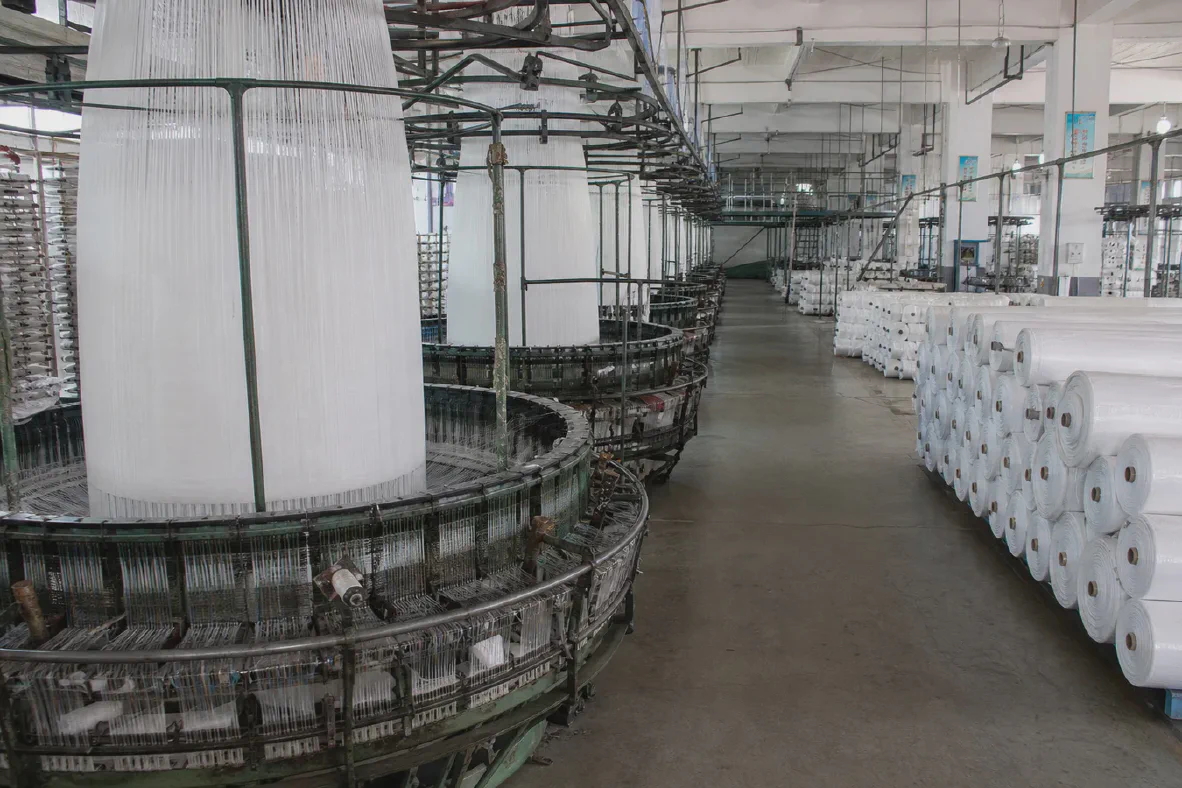
Weave density is the count of polypropylene tapes in the warp and weft. On this factory’s range it is written as 10x10 to 16x14. Buyers who only send GSM still get quotes that are not comparable, because a mill can hit the same weight with a coarser cloth and a heavier tape, or with a tighter cloth and a lighter tape.
This page is for bulk buyers of PP woven rolls and PE laminated tarpaulin rolls. It is not a finished-tarp catalog. Cutting, welding, sewing and eyelets stay on the converter side.
Count first, then GSM
GSM answers “how much polymer per square meter.” Weave answers “how that polymer is arranged.”
| Spec | What it measures | Why it changes the job |
|---|---|---|
| GSM | Mass of cloth, sometimes including PE film | Freight, stiffness, coverage |
| Weave density | Tapes per inch (or per 10 cm) in warp × weft | Tear path, coating hold, pinholes, appearance |
| Tape denier / tape width | How thick each tape is | Two mills can quote the same 12x12 at different GSM |
Read how to choose GSM together with this page. Do not treat either number as a stand-alone grade.
What 10x10, 12x12, 14x14 and 16x14 usually mean
Chinese export quotes almost always mean tapes per inch. Confirm that in writing. If a mill counts per 10 cm, a “10x10” on their sheet is not the same cloth as a 10x10 per inch.
| Written weave | Typical reading | What buyers use it for |
|---|---|---|
| 10x10 | Open industrial cloth | Cost-sensitive wrapping, some liners, short-use covers after coating |
| 12x12 | Mid-density workhorse | General tarpaulin conversion and many packaging rolls |
| 14x14 | Tighter face | Cleaner coating, slower tear, more yarn cost |
| 16x14 | Warp denser than weft | Outdoor cover programs that need extra warp hold without a full 16x16 cost |
These are starting labels, not test certificates. The same written weave can still differ if tape width, draw ratio or recycled content changes. Approve a sample, then lock the count on the order sheet.
16x14 is not a typing error. Warp and weft do not have to match. An unbalanced count is common when the mill wants more longitudinal tapes for winding and handling, while keeping weft cost down. Write both numbers. Do not round it to “16 mesh.”
Why two 100 GSM offers can feel different
A 100 GSM uncoated 10x10 roll is not the same product as a 100 GSM 14x14 roll, and neither is a 100 GSM finished laminated roll.
Before you compare price:
- Ask whether GSM is base cloth or finished laminated weight.
- Ask warp × weft and the counting unit.
- Ask one-side or two-side PE film.
- Ask virgin, recycled or mixed resin — see virgin vs recycled PP woven rolls.
- Ask open width (0.6–2.4 m on this site) and roll form — flat vs tubular.
A looser weave at the same GSM often means wider or heavier tapes. That can still convert, but the face looks coarser, coating can bridge over gaps, and a tear can run farther once it starts. A tighter weave at the same GSM uses more tapes and usually looks cleaner after lamination.
Laminated rolls: film is not weave
PE film can make a coarse cloth look closed until the converter processes it. For truck cover tarpaulin fabric rolls and other welded covers, check:
- coating adhesion on a peel strip;
- pinholes against light on a cut sample;
- weld or sew trial on the buyer’s method;
- whether the mill counted weave before coating.
Do not inspect weave only on a glossy laminated face. Count on an uncoated edge, a slit tube, or a small uncoated sample from the same loom setup.
For agriculture ground cover, a more open weave can drain; a denser or coated cloth holds water differently. State irrigation and whether you need water pass-through. Weave plus coating decides that more than the word “ground cover.”
How to write weave on the RFQ
Send one block, not a one-line GSM:
- application (tarp conversion, ground cover, packaging, site cover);
- structure (uncoated PP woven or PE laminated, one side or two);
- GSM basis (base or finished);
- weave: warp × weft and per inch or per 10 cm;
- color and UV target;
- open width and roll length or diameter limit;
- resin rule;
- quantity, packing and destination port.
Use the quote specification generator and compare two offers with the spec comparison tool. Weave belongs on that line next to GSM. The cost driver calculator ranks options; it is not a USD price list.
How to check a sample without a lab story
You do not need a full tensile report to reject a mismatch.
- Photograph the cloth against a window or lightbox and count tapes in 1 inch on warp and weft.
- Repeat in three places: near the edge, mid-width, and a second meter along the roll.
- Weigh GSM on a cutter sample and write whether the piece includes film.
- For laminated goods, peel a corner and look at the cloth underneath.
Put the counts on the quality inspection checklist. If the mill cannot tell you the counting unit, treat the quote as incomplete.
Mesh language from shade net, window screen or geotextile is a different product family. Do not paste a “120 gsm 10x10” bag-cloth nickname onto a tarpaulin roll program and assume the loom setup matches.
Related sourcing links
FAQ
Is weave density the same as GSM?
No. GSM is mass per square meter. Weave density is how many tapes sit in warp and weft. Two 100 GSM rolls can be a coarser weave with heavier tape, or a tighter weave with lighter tape.
What does 10x10 or 16x14 mean on a Chinese mill quote?
It is usually tapes per inch: warp count × weft count. Ask the mill to write the counting unit. Some plants count per 10 cm. The same cloth can look like two different numbers if the unit is not stated.
What weave range do you supply?
Common production on this site is 10x10 to 16x14, together with 55–260 GSM and open width 0.6–2.4 m. The usable combination still depends on yarn, coating and the converting line.
Should I pick the tightest weave for tarpaulin conversion?
Not automatically. A denser cloth can hold coating better and tear more slowly, but it also costs more yarn and can change stiffness and welding. Match weave to GSM, PE film and the converting method.
Can PE lamination hide a loose weave?
Yes. Film covers pinholes and a coarse face until the converter welds, sews or peels the sample. Count the weave on an uncoated edge or a cut strip, not only on the laminated face.
How do I write weave on an RFQ?
Write warp × weft, the counting unit, GSM basis (base cloth or finished laminated weight), coating side, width, UV and application. Do not send only “100 GSM roll”.