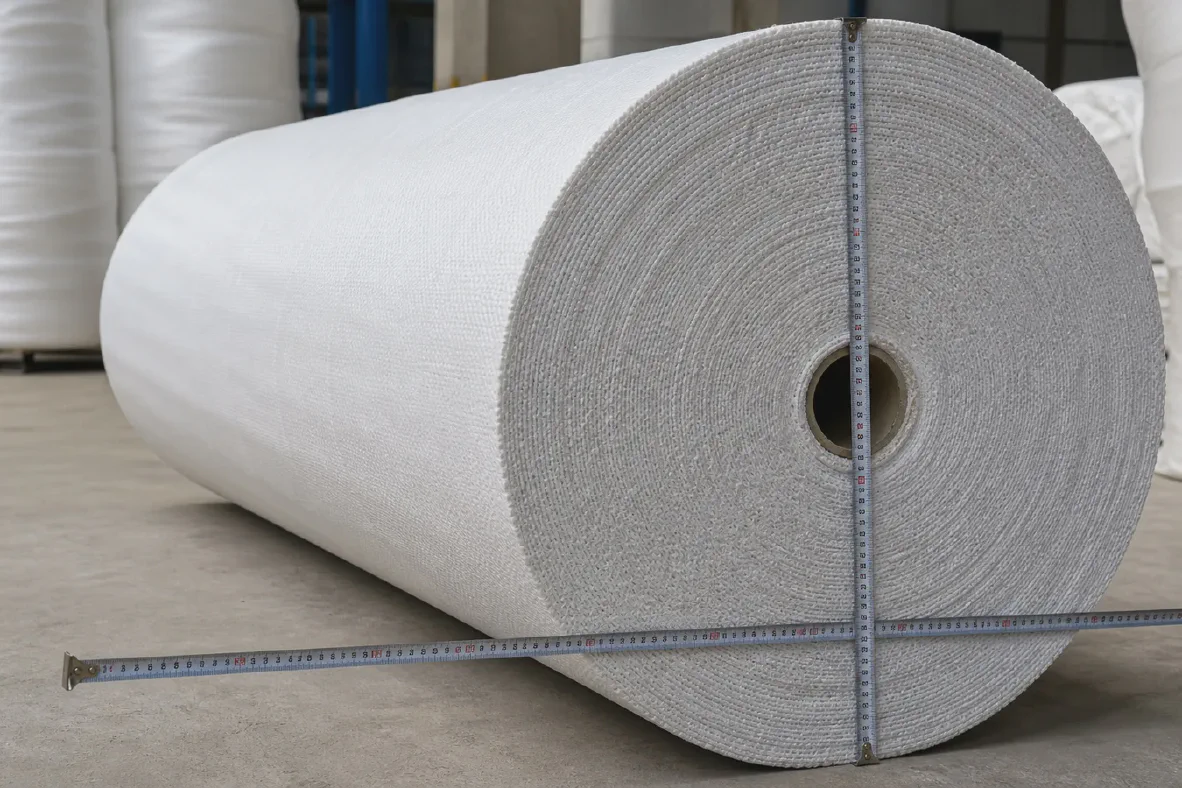
For a flat roll, the working formulas are:
- Coverage (m²) = width (m) × length (m)
- Fabric weight (kg) ≈ GSM × coverage (m²) ÷ 1000
Example: 2.0 m × 100 m at 120 GSM → 200 m² → about 24 kg of fabric, before tubes, wrap and moisture.
Use the roll weight calculator for the same math with quantity. This page explains what the number does not include.
What the simple formula misses
| Extra | Effect |
|---|---|
| Paper or plastic core | Adds kg per roll |
| Outer wrap / bag | Adds kg; small vs fabric but not zero |
| GSM tolerance | A ±5–8% band changes billed weight |
| GSM basis | Base cloth vs laminated finished GSM |
| Moisture / storage | Can shift weighbridge numbers slightly |
| Tubular fabric | Confirm whether GSM is one wall or both walls |
If a supplier quotes price per ton, convert with finished GSM and area, not with a guessed roll kg.
Coverage for converters
Coverage is the fabric area, not the finished tarp area. Cutting, overlap, hems and welding loss come off the converter’s yield. Roll width planning belongs in roll width for tarpaulin conversion.
Loading is a different calculation
Roll kg × number of rolls is not the same as “how many rolls in a 40HQ”. Diameter, stacking and payload limits decide that. Use the container loading calculator after you have roll diameter and packing method.
Worked comparison
Two quotes both say “100 GSM, 2 m × 100 m”:
- Quote A: 100 GSM base, then PE lamination (finished maybe 120–140 GSM).
- Quote B: 100 GSM finished laminated.
Quote A can look cheaper per roll and still ship more polymer. Ask which GSM is on the offer. See laminated vs unlaminated.
FAQ
Can I use this for tubular rolls?
Only after the plant defines width (lay-flat vs open) and whether GSM is one layer. Wrong width language doubles or halves the area.
Is this a customs or freight official weight?
No. It is a planning estimate. Booking and customs follow the packing list and weighbridge.